
6. Example 2: Turbidity Sampling with Low-Cost Technology


Introduction & Research Question
Across Sub-Saharan Africa, small wetland reservoirs are vital resources for local communities, yet maintaining their water quality remains a persistent challenge. Traditional water quality monitoring methods, especially for turbidity, often rely on expensive equipment and infrequent measurements, making continuous monitoring impractical for remote or resource-constrained areas. Turbidity, a key indicator of water quality, can significantly impact aquatic life and human health, especially in regions where water bodies serve as a primary source of drinking water and irrigation. This study aimed to evaluate the potential of low-cost turbidity sensors to offer a more accessible, cost-effective solution for real-time water quality monitoring, complementing satellite-based remote sensing.
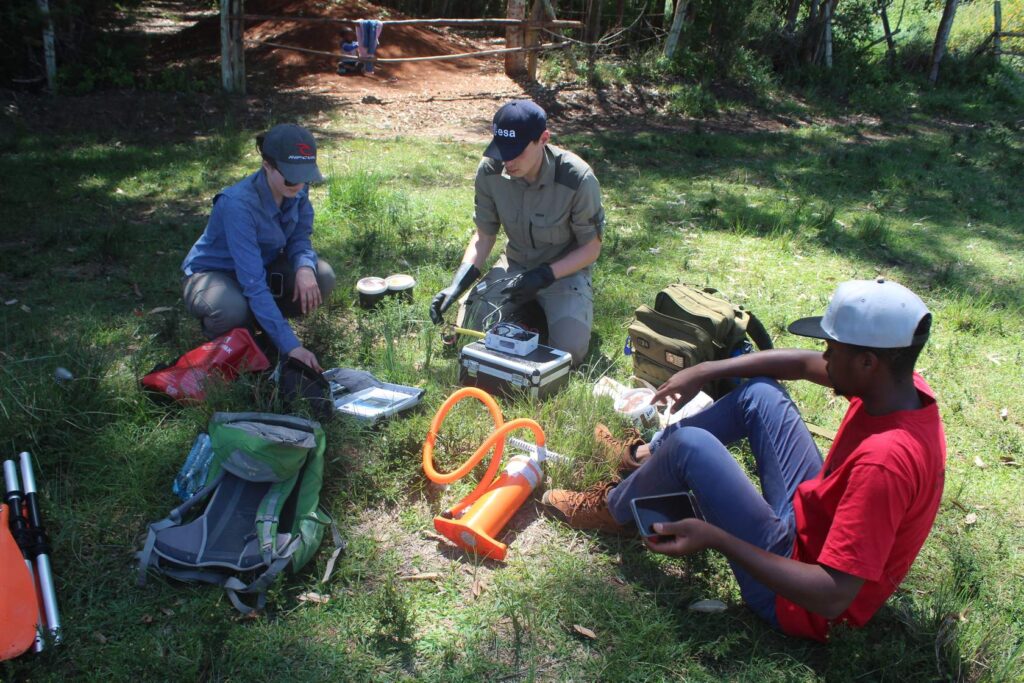
In this example, we explore a study that aimed to monitor turbidity—a key indicator of water quality—in small wetland reservoirs in Kenya. The research focused on evaluating the potential of low-cost turbidity sensors for operational water quality monitoring. The role of these sensors was to provide an affordable and accessible alternative for in-situ turbidity measurements, complementing satellite-based remote sensing. To achieve this, the researchers deployed low-cost turbidity sensors based on the DFrobot SEN0189, connected to Arduino microcontrollers. These sensors were tested alongside a commercial turbidimeter to assess their performance and feasibility for long-term water quality monitoring in wetland environments.

Objectives
This study aimed to address the challenge of spatially and temporally continuous water quality monitoring in small tropical wetland reservoirs with low-cost sensor technology and satellite remote sensing. The objectives are as follows:
to calibrate and assess the performance of two low-cost turbidity sensor types under field conditions.
to calibrate and apply remote-sensing turbidity models based on Sentinel-2 satellite imagery with turbidimeter and low-cost sensor ground measurements.
to evaluate the turbidity retrieval approach with respect to national water quality guidelines and to the potentials of technology integration in operational turbidity monitoring.
Low-cost turbidity setup
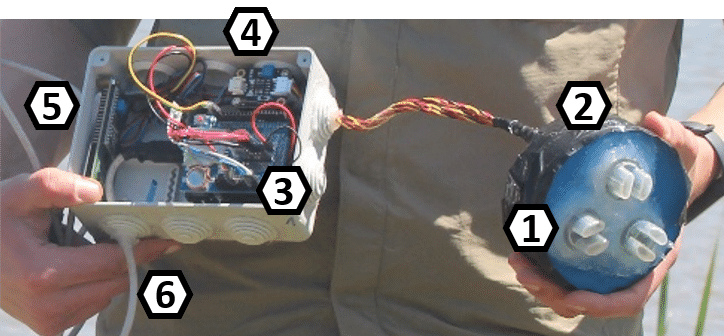
Three turbidity sensors of the same type were used simultaneously to analyse possible outliers. The measured values were shown directly on an LCD display as well as stored on an SD card, which was connected to the Arduino Uno microcontroller.
These turbidity sensors work by measuring the amount of light scattered by suspended particles in water. They use an infrared LED to emit light into the water sample and a photodetector positioned on its opposite to detect the scattered light. The more particles present in the water, the more light is scattered, leading to a higher turbidity reading.
The sensor outputs an analog voltage signal that corresponds to turbidity levels. The microcontroller converts the signal into Nephelometric Turbidity Units (NTU), which is the standard unit for measuring turbidity.
Image: Sensor setup with (1) turbidity sensor heads, (2) 3-D-printed casing, (3) Arduino uno with additional board and SD card reader, (4) turbidity sensor board, (5) LCD display, and (6) power supply.
- Summary
- The low-cost turbidity sensors, based on the DFrobot SEN0189 and Arduino microcontrollers, successfully monitored turbidity in wetland reservoirs, providing an affordable alternative to expensive methods.
- Although there were minor discrepancies compared to commercial turbidimeters, their calibration showed a strong correlation with actual turbidity levels, making them reliable for field use.
- These sensors are ideal for community-based water quality monitoring, offering continuous, real-time data in resource-limited areas, and supporting sustainable water management and environmental conservation.