


Lesson Progress
0% Complete
Normalized Difference Water Index (NDWI)
The Normalized Difference Water Index (NDWI) is a spectral index based on the principle that different surfaces reflect solar radiation in distinct ways (their spectral signatures).
NDWI is used to quantify the presence and concentration of water, both:
- within vegetation (liquid water in leaves), and
- on the Earth’s surface (e.g., rivers, lakes, floods).
Because these two applications rely on different spectral properties, two main NDWI formulations exist.
NDWI for Vegetation Water Content (Gao, 1996)
Formula
NDWI = (NIR – SWIR) / (NIR + SWIR)
- NIR = Near-Infrared band
- SWIR = Shortwave Infrared band
Purpose
- Estimates water content in leaves of plants and trees
- Sensitive to vegetation moisture and drought stress
Interpretation
- Reflects changes in:
- leaf water content
- internal leaf structure (mesophyll)
- Useful for monitoring vegetation in drought-affected regions
This means it does not measure water content directly, but rather correlates with vegetation moisture conditions.
NDWI for Surface Water Detection (McFeeters, 1996)
Formula
NDWI = (Green – NIR / Green + NIR)
- Green = Green spectral band
- NIR = Near-Infrared band
Concept
- Water bodies show low reflectance in NIR
- Vegetation shows high reflectance in NIR
This contrast allows clear separation of water vs. land/vegetation.
Applications
- Detection of surface water bodies
- Flood monitoring and water level changes
- Mapping aquatic environments
Key Takeaways
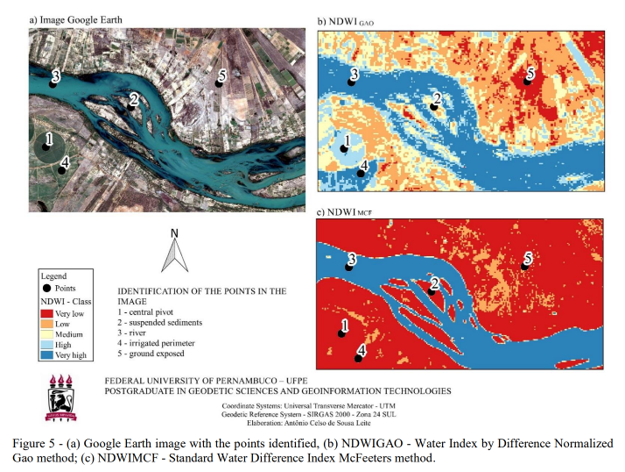
- NDWI is not a single index, but a family of indices with different purposes
- Two main use cases:
- Vegetation moisture (Gao, 1996)
- Surface water detection (McFeeters, 1996)
- Choice of spectral bands depends on the target phenomenon and available data
- Widely used in:
- drought monitoring
- flood mapping
- ecosystem and vegetation analysis